Faktowo
NASA: Mars programme technology captures CO2 in breweries
According to NASA, a system developed for the agency to capture CO2 from the Martian atmosphere is now used in beer brewing. It has also reached wineries and distilleries.
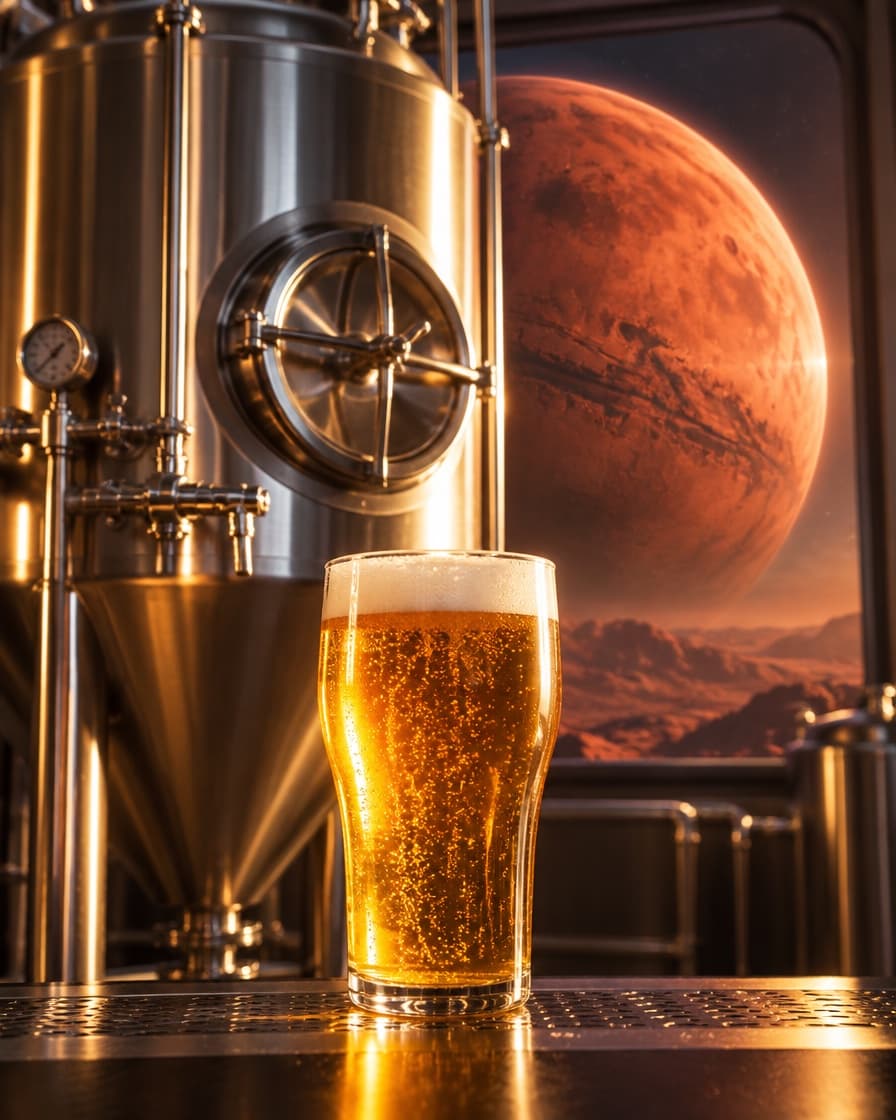 AI image
According to NASA, technology developed for the agency to capture carbon dioxide from the Martian atmosphere is now used to capture CO2 from the beer brewing process. The agency says it has also reached wineries, distilleries, the energy sector and helium production.
The atmosphere of Mars is made up mostly of carbon dioxide. That is why, in concepts for exploring the Red Planet, CO2 is the basic raw material for making fuel and water.
When a brewery ran out of CO2
In 2021, the carbon dioxide supplier for the Maine Beer Company brewery began to run short of the gas. In brewing, CO2 is produced during fermentation. It is also used to carbonate beer and as a protective gas when bottling.
Dave Love, the brewery's sustainability manager, said that without CO2 the beer in the tanks could spoil. The gas also could not be used for bottling, filling kegs or in centrifuges. According to Amy George of Earthly Labs, shortages and fluctuations in the availability of CO2 have continued since the pandemic. She says this is the main reason for interest in the technology. The experience of Maine Beer Company therefore shows the problem that is driving that interest.
From NASA contracts to beer
Since the 1990s, the company Pioneer Astronautics had won a series of SBIR contracts, a programme for small businesses, from the Johnson Space Center in Houston. They concerned building systems that produce resources on Mars. The technology was meant to capture CO2 from the Martian atmosphere and combine it with hydrogen. This would produce water to support life and methane as rocket fuel.
According to NASA, Pioneer's systems were not entirely novel in terms of their capabilities. They were, however, compact, efficient and automated. The company's founder, Robert Zubrin, later created Pioneer Energy, which turned these subsystems into technology for the oil and gas industry.
Zubrin noticed that the same solution could capture CO2 from the brewing process in a brewery and use it for carbonation. By 2015, the Craft Brewery Recovery System was in production. Pioneer Energy eventually put it up for licensing. In 2016, Amy George founded Earthly Labs in Austin, Texas, a company focused on small-scale carbon capture. She discovered the system and obtained an exclusive licence for it.
Earthly Labs has also taken the technology into wineries and distilleries. Its customers include energy companies, which often produce CO2 as a by-product and can sell it if it is captured. Several of them already use the solution.
Another application is helium production. Helium is used, among other things, to make microchips and optical fibres. It occurs in underground deposits mixed with other gases, such as methane and CO2, which have to be separated. In 2021, Earthly Labs was acquired by Chart Industries Inc., which specialises in cryogenic equipment. The company helped to scale up the technology, for example for power plants.
Why it matters
The story shows that a solution designed with Mars in mind can find use in ordinary production on Earth, from beer to helium. It is not known, however, how many installations and customers already use it. NASA says in general terms that the technology brings savings and environmental benefits, but it gives no figures. It is also not known whether the technology itself was actually used on Mars: these are systems designed and developed on Earth as part of the agency's plans.
- Źródło: NASA, NASA’s Machines for Mars Make Beer Bubbly, https://www.nasa.gov/technology/tech-transfer-spinoffs/nasas-machines-for-mars-make-beer-bubbly/
Put your brand inside a fact people save and share. Reach, examples and terms are on faktowo.partners.
Become a partner →